
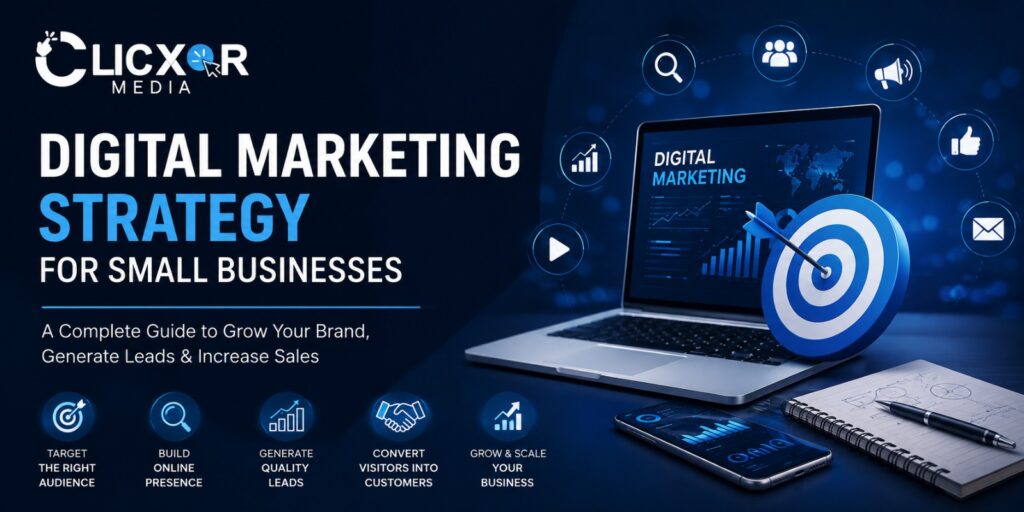
Digital Marketing Strategy for Small Business: A Complete Guide
Understanding the key components of an effective digital marketing strategy for small businesses involves understanding three main factors that can limit a small business: budget, time, and, of course, competition. Having an attractive website and a quality offering and maintaining high levels of client satisfaction are all excellent, but if potential customers cannot find your business online, achieving lead generation will be an uphill battle. One way to tackle the challenge of limited budget and high competition, while ensuring an excellent digital marketing strategy, is to focus on what will make the most significant positive impact on your business. Usually, that will involve mixing and measuring a combination of the following: search engine optimization (SEO), local search, online content, social media, paid ads, optimizing the conversion process, and reputation management. This guide will show you how to implement that marketing strategy step-by-step. What Is a Digital Marketing Strategy for Small Business? Having a digital marketing strategy means that a business has a clear idea of how to connect each element of online marketing to a goal that will lead to the growth of the business by bringing customers in, and by helping to establish trust and drive sales. A strategy means that a business will connect each element of its online marketing to a particular goal that will lead to a measurable outcome. A local business might connect each element of its online marketing to achieving a presence on the two primary Google platforms, while an online retail business might connect each element of its online marketing to achieving social media marketing, email marketing, and paid advertising. The right digital marketing strategy depends on: Getting traffic isn’t the goal. Getting the right traffic so those visitors will turn into customers is. Why Small Businesses Should Invest in Digital Marketing Strategy Big businesses can afford to splash out on branding. Small businesses must be much more targeted with their spend. A properly thought-out strategy will help small businesses: Google suggests that businesses create customer-targeted content, rather than just content to rank in search engines. Experience, Expertise, Authority and Trust are the leading qualities in content and Google suggests businesses focus on these. The Important Difference Digital marketing is much more than increasing website visitors. The goal is to develop a system guiding potential customers step by step through your marketing funnel: Awareness → Interest → Consideration → Trust → Action → Become a Repeat Customer The Small Business Digital Marketing Funnel 1. Start by Defining Your Target Audience A common pitfall for small businesses is attempting to market to the broad population. What you should do instead is narrow your focus on your ideal customers. Ask Yourself These Questions A good example of this is a digital marketing agency should never say their audience is simply business owners. That agency’s audience should be business owners of small to medium-sized businesses that want services that offer them online business growth by using SEO, lead generation, digital marketing, etc. The more thorough your audience understanding is, the easier it will be to develop offers and content that is relevant to your audience. 2. Develop a Website That Prioritizes Search Optimization The core of your digital marketing efforts lies within your website. Social media sites can change their rules, advertising costs can go up, policy shifts can happen with third-party platforms, but your website will always be the best place for potential customers to learn about you and your business and take action. Your Website Should Include: Your website shouldn’t be designed for search engines. Design it for the visitors who arrive on the page and ask, “Can this business solve my problem?” 3. Build a Strong SEO Strategy SEO can and should be focused on small business growth over time. SEO is beneficial to small businesses as it enables the business to be discoverable by consumers actively searching for products and/or services related to their business. A good small business SEO strategy should focus on three aspects: On-Page SEO This includes: Technical SEO This involves improvements to: Off-Page SEO This is where you establish strong authority with: The focus here should never be on quantity. Relevant and trustworthy authority matters more than simply building a large number of links. 4. Think Local When Needed If your business services a city or region and you want that business to grow, local SEO is a necessity. When customers search for local services, your Google Business Profile helps them find you. Important Local SEO Activities Include: Although it is more difficult to compete nationally for all digital marketing keywords, it is possible for a small-size agency to create content such as “Digital Marketing Agency in Lucknow” when creating marketing content relevant to their business location. Your website and local presence can be connected through consistent branding and relevant local information. If you are a business exploring digital marketing services, you can see online how an agency can use the example of Clicxor Media to position their services online. 5. Create Content That Answers Real Customer Questions Your content should help answer questions your potential customers actually ask before purchasing. For example, a web-development company could create content around questions such as: This approach helps with both traditional and AI-based search. Google’s current guidance for search generative AI focuses on creating content that cannot be found elsewhere and injecting personal opinions or experiences and expertise that cannot be found elsewhere. AEO-Friendly Content Structure When formulating an answer for a key question, do so in a clear, early and precise manner. What Is the Best Digital Marketing Strategy for a Small Business? While the best strategy is dependent on the marketing needs of the business, most small businesses should start with an easy-to-navigate website, local SEO, optimization of their Google Business Profile, creation of helpful content, website conversion optimization, and implementing measured and controlled paid campaigns. Then explain the details. 6. Use Social Media to Build Trust Social media marketing is about more than just making a […]