
Understanding the key components of an effective digital marketing strategy for small businesses involves understanding three main factors that can limit a small business: budget, time, and, of course, competition.
Having an attractive website and a quality offering and maintaining high levels of client satisfaction are all excellent, but if potential customers cannot find your business online, achieving lead generation will be an uphill battle.
One way to tackle the challenge of limited budget and high competition, while ensuring an excellent digital marketing strategy, is to focus on what will make the most significant positive impact on your business.
Usually, that will involve mixing and measuring a combination of the following: search engine optimization (SEO), local search, online content, social media, paid ads, optimizing the conversion process, and reputation management.
This guide will show you how to implement that marketing strategy step-by-step.
What Is a Digital Marketing Strategy for Small Business?
Having a digital marketing strategy means that a business has a clear idea of how to connect each element of online marketing to a goal that will lead to the growth of the business by bringing customers in, and by helping to establish trust and drive sales.
A strategy means that a business will connect each element of its online marketing to a particular goal that will lead to a measurable outcome.
A local business might connect each element of its online marketing to achieving a presence on the two primary Google platforms, while an online retail business might connect each element of its online marketing to achieving social media marketing, email marketing, and paid advertising.
The right digital marketing strategy depends on:
- Your industry
- Target audience
- Geography
- Competitors
- Customer value
- Budget
- Sales cycle
- Current online presence
Getting traffic isn’t the goal.
Getting the right traffic so those visitors will turn into customers is.
Why Small Businesses Should Invest in Digital Marketing Strategy
Big businesses can afford to splash out on branding. Small businesses must be much more targeted with their spend.
A properly thought-out strategy will help small businesses:
- Find and engage customers who are searching for the solutions small businesses offer
- Help small businesses establish credibility in the eyes of the customer
- Drive organic traffic with effective SEO
- Promote small businesses within their local area
- Start to capture leads with a website
- Encourage prospective customers to return
- Start building the brand
- Help small businesses understand the impact of their marketing
- Reduce the risk of relying on one marketing strategy
Google suggests that businesses create customer-targeted content, rather than just content to rank in search engines. Experience, Expertise, Authority and Trust are the leading qualities in content and Google suggests businesses focus on these.
The Important Difference
Digital marketing is much more than increasing website visitors.
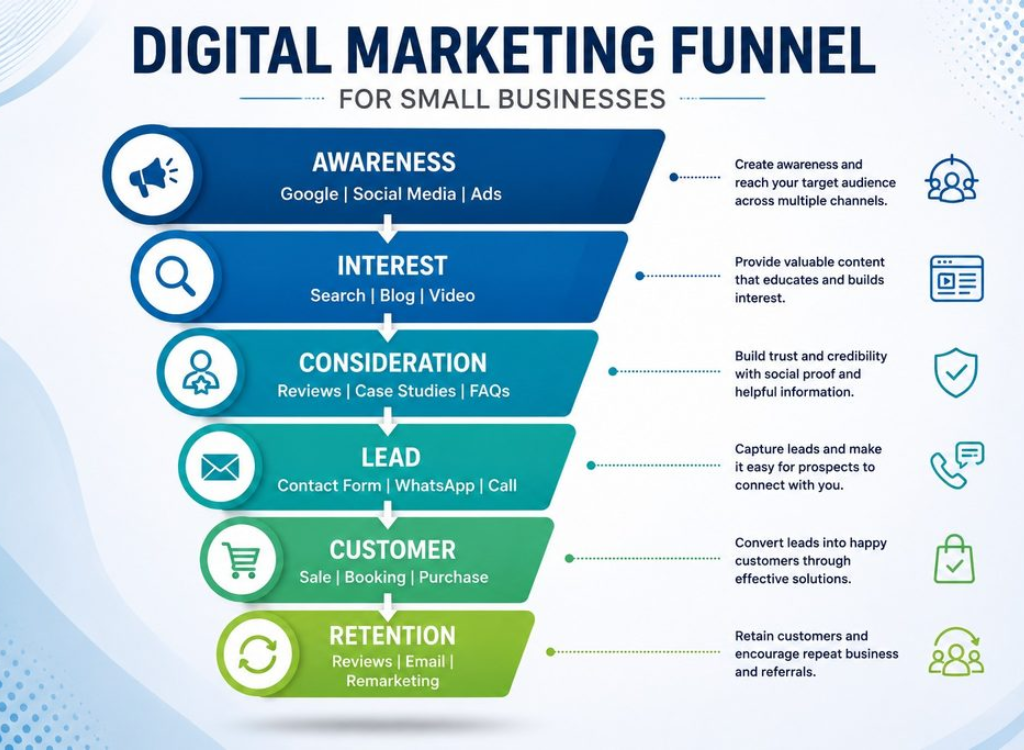
The goal is to develop a system guiding potential customers step by step through your marketing funnel:
Awareness → Interest → Consideration → Trust → Action → Become a Repeat Customer
The Small Business Digital Marketing Funnel
1. Start by Defining Your Target Audience
A common pitfall for small businesses is attempting to market to the broad population.
What you should do instead is narrow your focus on your ideal customers.
Ask Yourself These Questions
- Who would purchase my good/service?
- What needs would they fulfill by purchasing?
- What are the geographic boundaries of my ideal customers?
- What search terms would they use to find my good/service?
- What concerns would they have that would deter them from making a purchase?
- What would factor into their buying decision?
- What businesses would they consider that are similar to mine?
A good example of this is a digital marketing agency should never say their audience is simply business owners.
That agency’s audience should be business owners of small to medium-sized businesses that want services that offer them online business growth by using SEO, lead generation, digital marketing, etc.
The more thorough your audience understanding is, the easier it will be to develop offers and content that is relevant to your audience.
2. Develop a Website That Prioritizes Search Optimization
The core of your digital marketing efforts lies within your website.
Social media sites can change their rules, advertising costs can go up, policy shifts can happen with third-party platforms, but your website will always be the best place for potential customers to learn about you and your business and take action.
Your Website Should Include:
- Service or product pages
- Headlines
- Navigation
- Quick load times
- Responsive design
- Direct calls to action
- Informative contact section
- Visible reviews
- Trust indicators
- Relevant FAQs
- Well-formed title tags and meta descriptions
- Informative and concise URLs
- Internal linking
- Structured data
Your website shouldn’t be designed for search engines.
Design it for the visitors who arrive on the page and ask, “Can this business solve my problem?”
3. Build a Strong SEO Strategy
SEO can and should be focused on small business growth over time.
SEO is beneficial to small businesses as it enables the business to be discoverable by consumers actively searching for products and/or services related to their business.
A good small business SEO strategy should focus on three aspects:
On-Page SEO
This includes:
- Headings and page titles
- Content, keywords and search intent
- Images
- Internal links
- URLs
- Meta descriptions
Technical SEO
This involves improvements to:
- Crawl and index the site
- XML sitemaps and robots.txt
- Core Web Vitals
- The HTTPS protocol
- Canonical URLs
- Broken links and redirects
Off-Page SEO
This is where you establish strong authority with:
- Relevant backlinks
- Digital PR
- Business citations
- Industry directories
- Local mentions
- Partnerships
- Trustworthy reviews
The focus here should never be on quantity.
Relevant and trustworthy authority matters more than simply building a large number of links.
4. Think Local When Needed
If your business services a city or region and you want that business to grow, local SEO is a necessity.
When customers search for local services, your Google Business Profile helps them find you.
Important Local SEO Activities Include:
- Ensuring the accuracy of your business information
- Selecting the appropriate business categories
- Adding your services/products
- Uploading genuine business photos
- Publishing useful updates
- Encouraging customers to leave reviews
- Responding to reviews
- Ensuring consistency of your business information
- Creating webpage content that is relevant to your business location
Although it is more difficult to compete nationally for all digital marketing keywords, it is possible for a small-size agency to create content such as “Digital Marketing Agency in Lucknow” when creating marketing content relevant to their business location.
Your website and local presence can be connected through consistent branding and relevant local information.
If you are a business exploring digital marketing services, you can see online how an agency can use the example of Clicxor Media to position their services online.
5. Create Content That Answers Real Customer Questions
Your content should help answer questions your potential customers actually ask before purchasing.
For example, a web-development company could create content around questions such as:
- How much does website development cost?
- How long does it take to build a website?
- WordPress vs Custom website: which is better?
- How can a small business generate online leads?
- Why is my website not ranking on Google?
This approach helps with both traditional and AI-based search.
Google’s current guidance for search generative AI focuses on creating content that cannot be found elsewhere and injecting personal opinions or experiences and expertise that cannot be found elsewhere.
AEO-Friendly Content Structure
When formulating an answer for a key question, do so in a clear, early and precise manner.
What Is the Best Digital Marketing Strategy for a Small Business?
While the best strategy is dependent on the marketing needs of the business, most small businesses should start with an easy-to-navigate website, local SEO, optimization of their Google Business Profile, creation of helpful content, website conversion optimization, and implementing measured and controlled paid campaigns.
Then explain the details.
6. Use Social Media to Build Trust
Social media marketing is about more than just making a direct sale.
For many small businesses, the greatest return on investment may be the trust and brand recognition gained.
Depending on where your audience can be found, consider utilizing:
- YouTube
- Short-form video apps
Content Ideas for Social Media
Provide content such as:
- Educational tips
- Behind-the-scenes content
- Customer and case content
- Product exhibits
- Demonstrations
- Answers to frequently asked questions
- Industry insights
- Team and industry content
- Before-and-after exhibits
The goal of this type of content is to make your business known to potential customers long before they are ready to make a purchase.
7. Use Paid Advertising Strategically
While your target audience may not be aware of your business upon the initiation of a paid advertising campaign, this visibility may be gained more quickly.
However, small businesses should avoid utilizing paid campaigns without tracking conversions to ensure a return on investment.
Depending on the goal of the business, paid advertising may consist of:
- Google Search Ads
- Display campaigns
- Social media advertising
- Remarketing
- Shopping campaigns
- Local campaigns
When you decide to implement paid advertising, it’s essential to have a specific goal in mind.
Instead of:
“We want more website traffic.”
Say instead:
“We want 30 qualified enquiries per month at an acceptable cost per lead.”
That goal will uniquely determine the structure of the campaign and the metrics used to assess the outcome.
8. Optimize Your Website for Conversions
Gaining traffic is only step one of the many goals of a successful business.
For example, if you gain 1,000 website visitors, but only a single person contacts you for further business, that’s a problem.
The issue could be conversion optimization instead of traffic.
Consider the Following:
- Call-to-action placement
- Contact forms
- WhatsApp buttons
- Phone numbers
- Service page structure
- Pricing information
- Testimonials
- Trust signals
- Case studies
- Page speed
- Mobile experience
A call-to-action (CTA) should provide clear instructions.
Examples Include:
- Get a Free SEO Audit
- Request a Consultation
- Get a Quote
- Talk to Our Marketing Team
Visitors should not have to guess the next step.
9. Build Trust With E-E-A-T Signals
Ranking on Google does not guarantee visitors will trust your business.
Your website should support your claims.
Recommended Trust Signals Include:
- Author information
- Company information
- Real business experience
- Case studies
- Client testimonials
- Reviews
- Contact information
- Clear service information
- Original photographs
- Credentials where relevant
- Transparent policies
- Accurate claims
Google describes E-E-A-T as Experience, Expertise, Authoritativeness and Trust, noting that trust is the most critical element.
A marketing agency can illustrate E-E-A-T through authentic case studies, technical insights, and clear reporting instead of made-up claims.
10. Track Leads, Not Just Rankings
The ability to measure your marketing efforts and their impact on your business is one of the most essential aspects of a small business marketing strategy.
In Addition to Tracking:
- Keyword rankings
- Impressions
- Website visitors
You Should Also Track:
- Phone calls
- Contact-form submissions
- WhatsApp enquiries
- Quote requests
- Product enquiries
- Bookings
- Add-to-carts
- Purchases
- Cost per lead
- Conversion rate
- Revenue
A keyword ranking in position #1 is valuable only if it contributes to the business.
A Basic Measurement Model
Traffic → Leads → Qualified Leads → Customers → Revenue
This shows which marketing activities help your business grow.
Small Business Digital Marketing Strategy
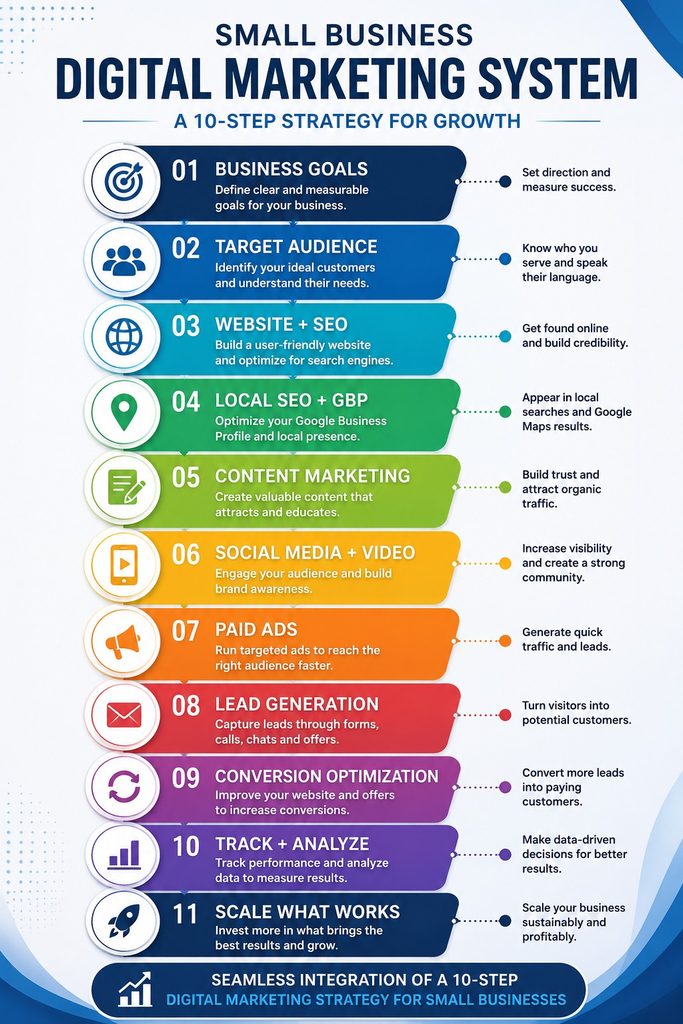
A Straightforward 90-Day Digital Marketing Strategy
Start building your marketing strategy step-by-step rather than trying to do everything at once.
Days 1–30: Building the Foundation
- Complete an SEO website audit
- Do keyword research
- Define your ideal target customer
- Resolve primary technical SEO concerns
- SEO optimize core website pages
- Set up Google Analytics and optimize for goal tracking
- Optimize your Google Business Profile
- Draft a content marketing strategy
Days 31–60: Building Visibility
- Publish helpful blog content
- Build backlinks
- Enhance local citations
- Post on social media
- Publish case studies
- Optimize the service pages on your website
- If it is on target, begin a paid marketing campaign
Days 61–90: Optimize and Scale
- Analyze where you stand in search engine rankings
- Evaluate the quality of your website traffic
- Assess the quantity and quality of leads
- Identify your website pages that perform the best
- Optimize for lead conversion
- Increase your content focus on successful SEO keywords
- Update and optimize your content marketing
- Increase activity on the marketing channels that are bringing you qualified customers
Your strategy should be built on what you know, not what you think.
AEO, GEO and AI Search: What Small Businesses Should Know
Search is evolving.
Google now has AI Overviews and AI Mode. Google says the fundamentals of SEO are still important for these products because they use Google Search and use content from the web that’s been indexed.
This means companies do not need to try to outrun every product that Google releases or every “AI ranking trick.”
Businesses Should Focus on:
- Making content that is helpful
- Making content that clearly answers questions
- Showing real knowledge and experience in the subject
- Keeping content up to date with accurate information
- Building a website that is user friendly
- Creating original content and experiences
- Building a reputation as a trustworthy business
Google says that keeping your site indexed in Search and meeting the requirements for normal Search is the only way to be featured as a supporting link in AI Overviews and AI Mode.
That means SEO is still important and AEO/GEO/AIO will work with SEO and not replace it.
Common Digital Marketing Mistakes Small Businesses Should Avoid
1. Using Too Many Marketing Channels
Concentrate on the marketing channels your customers actually use.
2. Buying Low-Quality Links
Links that are not relevant will not build any meaningful authority and will create risk.
3. Using AI Content Without Adding Value
Having AI generate the content is fine. But content should still have expertise and an editing touch. Google does not support having low-quality AI content created in mass.
4. Not Using Local SEO
Local channels can provide the most customers for your business, so be visible there if your customers are.
5. Measuring Vanity Metrics
Having more followers and impressions may not equal having more revenue.
6. Forgetting Conversion Optimization
More visitors won’t fix a website that doesn’t persuade people to take action.
Frequently Asked Questions
Which Digital Marketing Methods Work Best for Small Businesses?
The best methods incorporate building a digital presence that brings customers to a conversion-focused website. This can include SEO, including Local SEO, content marketing, reputation building, and lead generation.
What Is a Good Small Business Digital Marketing Budget?
Budgeting for digital marketing should focus on the business’s customers and goals. Competitive small business digital marketing pricing can help determine a useful budget, but if sustainable, spend to measure the cost per qualified lead and customer acquisition.
Is SEO a Better Investment for Small Businesses Than Advertising?
SEO is great for investment in long-term visibility, but if a business is looking for short-term paid traffic, then advertising can be a better investment. In most cases, either method can be useful if both are employed strategically.
When Should a Small Business Expect to See Results From Digital Marketing?
The time it takes for digital marketing to produce results will depend on the marketing methods employed and the business’s competition. Typically, paid digital marketing campaigns can produce results faster than SEO and content marketing.
Does a Small Business Need Social Media?
Social media for a small business is useful when the target customers are active on those platforms and the business can consistently create and publish relevant content. The right platforms depend on where potential customers spend their time.
How Can a Small Business Improve Website Lead Generation?
This can be accomplished by increasing the relevance of website traffic, having strong service pages, including calls to action on every page, building trust through reviews or case studies, having a simpler form, and tracking conversions.
Can AI Assist With Digital Marketing Tasks?
Yes, AI is good for a lot of things, from research to idea generation to organizing content to various forms of analysis. However, for digital marketing, companies must focus on providing their personal seal of expertise, accurate information, and significant value rather than publishing a lot of repetitive, pointless content.
Conclusion
An effective small business digital marketing plan is not about showing up everywhere.
It is about showing up where it matters, being useful to the right audience, and being easy to approach and trustworthy.
The Basics:
- Know your audience.
- Build a solid website.
- Invest in SEO.
- Focus on local visibility.
- Create valuable content.
- Build reputation and trust.
- Use social media strategically.
- Test paid ads.
- Improve conversions.
- Measure leads, customers, and sales.
The businesses that understand their customers, provide better information, and build trust are the ones that win online.
Most of the time, these businesses have a smaller budget than their online competitors. Winning online is more about trust, better information, and improving marketing from what you have learned than budget.
Clicxor Media and its digital marketing services can be a solution for small businesses that want to learn more and need help with local SEO, outreach, content, and lead generation.
Your goal is not to get more clicks.
Your goal is to get the clicks that count.