Picture a customer typing a search into Google for a web development company. That customer goes to your website, looks at your services, reviews your portfolio, and reads about your business before reaching
Now picture another customer clicking a Google ad and arriving on a focused landing page that offers a consultation and a simple enquiry form.
Both visitors can become customers. Their online experiences differ.
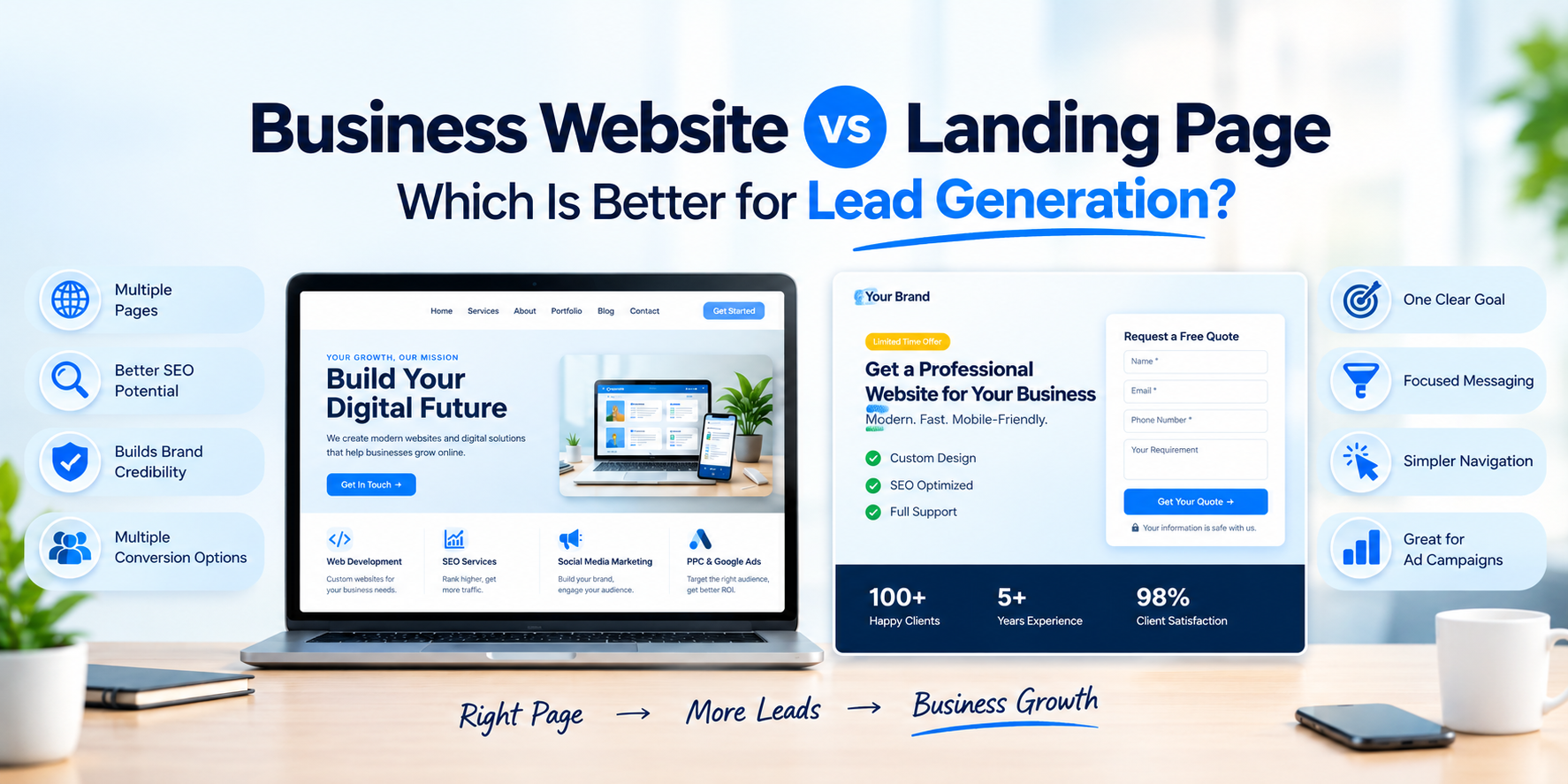
This is where the debate about website versus landing page becomes important. A business website helps people discover, understand and trust your company. A landing page, on the hand, directs visitors toward a specific action, like booking a call, asking for a quotation or sending their contact details.
So which option is better for generation?
The answer depends on your business goals, traffic sources, marketing budget and the customer journey. In situations the best strategy is to use a well‑designed business website for long‑term growth and to use dedicated landing pages for specific campaigns that drive lead generation.
In this guide, you will learn the differences between a business website and a landing page, the advantages of each, the costs to consider and how to choose the option for your business.
What Is a Business Website?
A business website is a space that shows who you are what you do and how people can reach you. It answers questions customers might have and gives them clear ways to get in touch. Most of the time a website has pages and each one has its own job.
For instance a digital marketing agency might have a homepage that gives an overview. Then there’s an About Us page that shares the story of the company. There could be a page for SEO services, another for web development and a portfolio to show past work. A blog helps share tips and ideas and the Contact Us page makes it easy for people to send a message.
Every single page plays a part in helping visitors learn more about the business. One page might focus on services, another, on success stories. Each one adds a piece to the picture of what the company stands for.
Key Features of a Business Website
- Pages: Visitors can look through services, company details, case studies and contact information.
- Search engine visibility: Each individual page can focus on search terms and bring in free traffic from search engines.
- Brand credibility: A clean design, clear business information, real customer reviews and good examples of work can help people trust the business.
- Multiple conversion opportunities: Visitors can call, send a WhatsApp message fill in a form or schedule a meeting.
- Long-term scalability: More service pages, blog posts, FAQs and new products can be added as the business expands.
A business website is especially helpful for companies that want customers to find them on Google learn about their skills and check their services before deciding.
For example someone looking for website development services, in Kanpur may want to see providers learn how they work, look at past projects and ask for a quote. A full business website can provide all these answers in one place.
What Is a Landing Page?
A landing page is a web page built with one main goal in mind. That goal could be to get people to ask questions schedule a meeting sign up for something or take advantage of a deal.
It’s different from a website because it keeps things simple. There are no links or menus to confuse visitors. Everything on the page points toward one action.
For instance a company that builds websites might run a Google ad to reach people in e-commerce. They could design a landing page, for business owners who want to start selling online.
On that page you might see a headline, a list of benefits samples of past websites they’ve made a short form to send a message and a button that says “Get Your Website Quote.” All of it is meant to guide the visitor to take the step.
Key Features of a Landing Page
- One primary objective: The content supports a specific campaign or conversion goal.
- Focused messaging: The headline and benefits address a particular audience or problem.
- Clear call to action: Visitors are encouraged to take one main action.
- Simple conversion journey: Unnecessary navigation and form fields can be reduced.
- Campaign tracking: Proper analytics can help measure enquiries, conversion rates, and campaign performance.
A landing page does not have to be a separate website or domain. It can be published as a page within your existing website.
The key difference is its purpose: a business website supports multiple user needs, whereas a dedicated landing page focuses on a particular action.
Website vs Landing Page: Key Differences
The following comparison explains how the two options differ in terms of marketing, design, SEO, and lead generation.
| Comparison Factor | Business Website | Landing Page |
|---|---|---|
| Main purpose | Present the complete business | Encourage one specific action |
| Structure | Usually multiple pages | Usually one focused page |
| Navigation | Multiple menu options | Limited or simplified navigation |
| Content | Company, services, portfolio, FAQs, and more | One offer, audience, or campaign |
| SEO potential | Supports multiple keywords and search intents | Can target a specific topic or offer |
| Paid advertising | Can work, depending on the destination page | Often useful for focused ad campaigns |
| Brand building | Supports broader brand discovery | Reinforces a specific campaign message |
| Lead generation | Offers multiple conversion paths | Directs visitors towards one primary conversion |
| Best suited for | Long-term business growth | Targeted campaigns and offers |
| Expansion | New pages and sections can be added | New campaigns may require additional pages |
Important: A landing page does not automatically generate more leads than a business website. Results depend on traffic quality, offer relevance, page speed, messaging, user experience, and the effort required to convert.
Which Is Better for Lead Generation?
There is no winner. The right choice depends on where your visitors come from and what they need before contacting you.
1. Choose a Business Website for Organic Lead Generation
If you want potential customers to find your business through Google searches having a complete website is usually the starting point.
You can build pages for each service you offer and share helpful articles that answer common questions people might have. Every page that matches what someone is looking for can bring in visitors who’re interested, in that specific topic.
For example a web development company could create pages for:
- Business website development
- E-commerce website development
- WordPress website development
- Website redesign services
- Website maintenance
These pages help people who might want to use your service figure out what they need before they ask for more information.
A website also lets visitors have chances to check out your business by showing real projects details about the work you do how to get in touch and clear ways to see how things work.
To get customers in a way that keeps going over time focus on good information, search engine optimization links, inside the website making sure it works on phones and making it easy for people to take the next step.
2. Choose a Landing Page for Targeted Advertising
If you are using Google Ads, Meta Ads or a campaign that is pushing a service a landing page can offer a more direct experience.
Imagine a company that is promoting low-cost e-commerce website development. Taking every visitor to a homepage might make them have to look for the service they need on their own.
Instead a special landing page can keep the message that is, in the advertisement and can explain:
- What service is being offered
- Who the service is suitable for
- What business problem it solves
- What the customer should expect
- How to request a quotation
Consistency makes it easier for visitors to understand the offer.
A designed landing page can also make campaign measurement simpler. You can track form submissions, qualified enquiries, phone calls and booked consultations to understand whether the campaign is producing results.
However paid traffic alone does not guarantee leads. Audience targeting, ad relevance, offer quality and follow-up processes still matter.
3. Use Both for a Stronger Lead Generation Strategy
For growing businesses using a business website along with focused landing pages gives the most room to adjust and grow.
Your website is the place where people find out about your business and what you do. It helps people find you when they search online. Your landing pages are made for goals. Like a special offer, a certain group of customers or an ad campaign.
Take an agency for example. Its main website can describe all the services it offers and share articles that show up in search results. At the time it can build a separate landing page just for a Google Ads campaign that pushes website development packages.
People who find the company by searching online can learn more about its work and experience. People who click on a paid ad go to a page that matches what the ad was, about.
These two types of pages work together. They don’t do the thing but they help each other out.
Business Website vs Landing Page: Which Is Better for SEO?
If your goal is to attract organic traffic over time, a business website generally offers more room to build search visibility across multiple topics.
A website can contain service pages, location-specific pages where genuinely relevant, educational blogs, case studies, and detailed FAQs. Each page can serve a distinct search intent.
A landing page can also rank in search engines if it offers useful content and meets the needs of a relevant query. However, a short campaign page created primarily for paid advertising may not provide enough depth to satisfy broader informational searches.
For example, a page targeting “website development services” serves a different intent from a blog explaining “website vs landing page.”
To strengthen SEO performance:
- Assign a clear primary search intent to each page.
- Write descriptive titles, headings, and meta descriptions.
- Create useful, original content that answers real customer questions.
- Link relevant blog articles to the appropriate service pages.
- Optimise page speed, mobile usability, and technical accessibility.
- Use relevant structured data only when the page and business meet its requirements.
For this article, the primary keyword is “website vs landing page.” The natural next step for readers who need a professional website is to explore Clicxor Media’s web development services.
This internal link connects an informational article with a relevant service page without forcing a sales message into every section.
How to Build a Landing Page That Generates Quality Leads
A landing page should do more than collect contact details. It should attract the right prospects and help them understand why they should take the next step.
1. Write a Clear, Benefit-Focused Headline
Tell visitors what you offer and why it matters. Don’t use phrases that could apply to any business.
For example: “Get a Professional Business Website Designed Around Your Growth Goals.”
Make sure your headline matches the promise in your ad or promotional message. Keep it clear and specific.
2. Explain the Value of Your Offer
Our service offers real-world advantages that your project can truly use. These can vary based on what you need. Some examples are a design that works on phones a simple way to update your website forms to get customer questions and a setup that is ready, for selling things online. We only talk about features that we can actually provide.
3. Add Trust-Building Information
Use testimonials, use relevant portfolio examples use clear contact details and use accurate information, about your process. If you publish case studies explain the project scope. Explain the results honestly.
Do not invent reviews do not invent client numbers do not invent awards do not invent performance claims.
4. Keep the Enquiry Form Simple
Ask for the information needed to start the conversation. A form, for a consultation may need a name, contact detail and a brief description of the requirement.
Complex projects may justify additional questions but every extra field should have a purpose.
5. Make the Call to Action Specific
I suggest using labels such as “Request a Website Quote ” “Book a Consultation,” or “Discuss Your Project.” The action should clearly tell visitors what will happen next of relying on vague words such, as “Submit.”
6. Measure Leads and Lead Quality
Track events, like successful form submissions, qualified phone calls, WhatsApp messages and scheduled meetings.
Don’t just look at the number of form submissions. A campaign that has more relevant messages might bring more value to the business.
Common Mistakes Businesses Should Avoid
Even a professionally designed website or landing page can underperform when the conversion journey is poorly planned.
Sending all advertising traffic to the homepage: A homepage may not address the specific offer in the advertisement. Test a relevant service page or dedicated landing page instead.
Using too many competing calls to action: Multiple equally prominent actions can make the next step unclear. Establish one primary conversion goal for each page.
Ignoring mobile visitors: Forms, buttons, text, and navigation should work comfortably on smaller screens.
Making unsupported promises: Guaranteed rankings, unrealistic lead numbers, or unverified claims can undermine trust.
Forgetting follow-up: Enquiries need a timely, professional response. A good page cannot compensate for a slow or inconsistent sales process.
Ignoring measurement: Without reliable tracking, it is difficult to identify which pages, campaigns, and traffic sources produce qualified leads.
Treating design as the only success factor: Strong results require alignment between audience intent, content, usability, traffic quality, and the sales process.
Frequently Asked Questions (FAQs)
1. What is the main difference between a website and a landing page?
A business website provides information about a company across multiple pages, while a landing page focuses on one primary conversion goal, such as generating an enquiry or booking a consultation.
2. Is a landing page better than a website for lead generation?
A landing page can be effective for targeted campaigns because it focuses attention on one offer. A business website is valuable for organic discovery, credibility, and multiple services. The best choice depends on your traffic source and business objective.
3. Can a landing page rank on Google?
Yes. A landing page can rank if it provides relevant, useful content and meets the searcher’s needs. Rankings are not guaranteed, and a page created exclusively for a paid campaign may not be suitable for broader organic searches.
4. Do small businesses need both a website and a landing page?
Not always at the beginning. A small business can start with a professional website that includes clear service information and enquiry options. It can add dedicated landing pages when specific campaigns or offers justify them.
5. Can I create a landing page without a website?
Yes. A landing page can exist independently, including on a separate domain or a landing-page platform. However, a standalone page may not provide the same breadth of business information, organic content, and long-term flexibility as a complete website.
6. What should a lead generation landing page include?
It should generally include a clear headline, relevant benefits, a specific offer, trust-building information, a prominent call to action, an appropriate enquiry form, and reliable conversion tracking.
7. Should Google Ads traffic go to a homepage or landing page?
Send visitors to the page that best matches the advertisement and their search intent. A relevant service page may be sufficient, while a dedicated landing page can be useful for a focused offer or campaign.
8. Which option is more affordable: a website or a landing page?
Costs depend on design complexity, functionality, content, integrations, and ongoing maintenance. A simple landing page may cost less to build initially, but the best investment is the option that meets your business needs without creating unnecessary limitations.
Conclusion: Website or Landing Page — What Should You Choose?
The decision between a business website and a landing page is not about finding one solution that fits all businesses. It is about making sure the correct page is used for the group of people and the correct goal.
Pick a business website if you want an online presence several service pages, visibility in search engines and a place where customers can learn about your company before getting in touch.
Pick a landing page if you want to highlight an offer back a focused advertising campaign or lead visitors toward one specific action.
For businesses that are thinking about growing over time a good website along with targeted landing pages can help with both finding customers and turning them into leads.
If your business wants a easy-to-use website that helps with your marketing goals check out Clicxor Media web development services. A clear website layout, useful content and smart paths, to conversion can help turn website visitors into business opportunities.