SEO vs Google Ads vs Social Media: Which Marketing Channel Is Best?Choosing the digital marketing channel can really impact how fast your business grows. You might have a website, a solid product and dependable service. Still you could be having trouble getting visitors or finding quality leads. Sometimes the issue isn’t your business all. It’s that you’re using the marketing method for what you want to achieve.
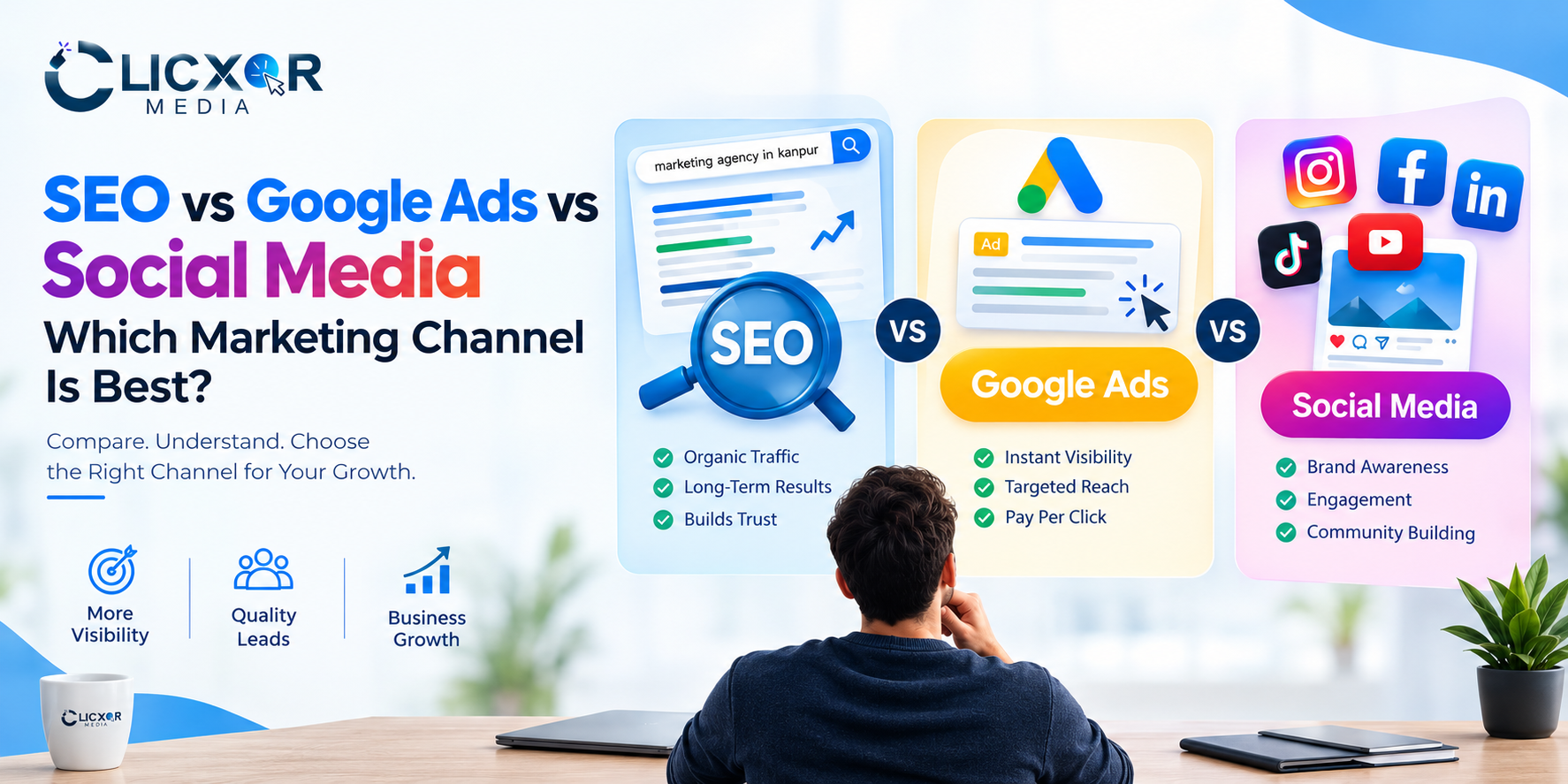
When you look at SEO Google Ads and social media marketing each one works differently to connect with customers. SEO helps your website appear in search results without paying for ads. People find you naturally when they search for things you offer. Google Ads lets you show your business to people who are actively looking for your products or services. You pay for each click or impression. Social media marketing is about building brand awareness creating connections with your audience and getting people to interact with your content.
So which one should you pick? Should you go with SEO for long-term results? Use Google Ads to get leads ?. Focus, on social media to grow your brand?
The right choice depends on your audience, your budget, how competitive your market’s how long your sales process takes and what your business wants to achieve. In this guide we will compare all three channels look at what each one does point out the things that limit them and help you decide where to put your marketing money.
What Is the Difference Between SEO, Google Ads, and Social Media?
I think SEO, Google Ads and social media marketing are three digital marketing channels but SEO, Google Ads and social media marketing each have a different purpose.
SEO helps your website appear higher in free search results. I see that SEO means making your site easier for search engines to read and find. SEO fixes content, improves speed links pages inside your site and does tweaks so that Google and other engines can understand what your pages are about.
Google Ads is a paid platform that lets businesses show ads when people search for words or on other sites. I notice that Google Ads usually costs when someone clicks on your ad depending on the bidding model you choose.
Social media marketing uses places, like Instagram, Facebook, LinkedIn and YouTube to show a brand, share posts talk with followers and bring in leads or sales. I find that social media marketing uses both posts and paid ads.
I think the main difference is how SEO, Google Ads and social media marketing find customers. SEO captures search interest Google Ads fights for paid spots and social media marketing reaches and influences people with posts and targeted campaigns.
1. What Is SEO and How Does It Work?
SEO stands for Search Engine Optimization. It is the process of improving a website so that relevant pages can appear prominently in unpaid search results.
For example imagine someone searches for ” marketing agency in Kanpur.” If your agency has a optimized website, useful service pages, relevant local information and credible content it may become visible, for that search.
SEO does not guarantee rankings. Results depend on competition, website quality, relevance, technical health and many other factors.
Benefits of SEO
1. Builds long-term organic visibility
A useful page that ranks well can bring in the kind of visitors for a long time. Unlike an ad that stops getting shown once the campaign ends a page that ranks organically keeps bringing in traffic on its own. It stays strong long as it stays relevant and useful.
2. Attracts people actively searching for solutions
SEO can bring your business closer, to users who are looking for services, products or answers.
If someone is searching for “website development company ” that person may already be evaluating providers.
3. Supports trust and credibility
Helpful content, business information, relevant case studies and a good website experience help potential customers evaluate your expertise before they contact you. I notice that this approach lets people see how well you can help them..
4. Creates opportunities for consistent lead generation
I have seen how targeted service pages and informative blogs pull in visitors when visitors first start thinking about buying. Then when visitors see conversion-focused pages visitors often send enquiries make calls or fill out form submissions.
Limitations of SEO
SEO is a job that needs work and patience. A new website might take months to get organic visibility but the time can differ a lot. When keywords are competitors SEO might need more content, technical fixes and building authority.
SEO also requires watching. The need, for search, rivals and the engine itself can shift,. The rankings and traffic that SEO brings are not guaranteed.
When Should You Choose SEO?
SEO is a choice if your business wants to create natural traffic bring in customers who are looking for your services increase how visible you are, in your area and create a long-term way to get new leads.
Check out Clicxor Media SEO services to see how a clear SEO plan can help your business be more visible online.
2. What Is Google Ads and How Does It Work?
Google Ads lets businesses put ads on approved Google spots, such as Google Search. Search campaigns can help your business show up when people look for products or services, like yours.
For example a company that offers website development can make a search campaign aimed at the questions. When users type those questions an approved ad might appear depending on the auction targeting, ad quality and other factors.
Google Ads can bring traffic soon after a campaign gets approved and starts running.. Quick traffic does not automatically mean quick sales.
Benefits of Google Ads
1. Faster opportunity to reach potential customers
SEO normally needs time to create visibility. Google Ads can start showing impressions and clicks quickly after you launch. The actual delivery of Google Ads depends on approval, competition, budget, targeting and search demand.
2. Reaches high-intent audiences
Search advertising reaches people who are actively searching for services. Using the keywords clear ad copy and landing pages that match what users are looking for can bring in potential customers who are ready to make an inquiry.
3. Offers measurable campaign data
I see that advertisers can track how many times an ad is shown how many clicks it gets, the click‑through rate, how many people convert and how much the ads cost. When conversion tracking is set up correctly conversion tracking shows which campaigns are really producing business results.
4. Provides flexibility
You can change budgets stop campaigns try messages and improve targeting as you find out more, about your customers. This ability to change is very helpful when you are starting a service or checking if people want it in an area.
Limitations of Google Ads
Google Ads needs a budget, for advertising and some popular words to target can cost a lot. The money keeps going long as you are paying for the ads and not every person who clicks on the ad ends up buying something.
Choosing the words having a bad page where people land, not tracking sales properly or not making the offer clear can make the money disappear. So ads should be. Improved often instead of just turning them on and forgetting about them.
When Should You Choose Google Ads?
Google Ads can work well if you want to get leads push a limited-time deal try out a new service or reach people who are already looking for a solution.
To get results use the right keywords make sure your offer is clear have a fast-loading landing page and track conversions properly.
Find out more, about Clicxor Medias PPC marketing and Google Ads services.
3. What Is Social Media Marketing and How Does It Work?
Social media marketing helps businesses connect with their audiences through platforms such, as Instagram, Facebook, LinkedIn and YouTube.
Unlike search advertising, which often responds to an existing search social media marketing can introduce social media marketing to people who may not yet know that social media marketing offers a product or service. I have seen many brands benefit from this approach.
For example a fashion brand can use Instagram Reels to showcase collections while a B2B company can share LinkedIn insights to demonstrate industry knowledge and build professional relationships. It feels rewarding to watch audiences engage with content.
Benefits of Social Media Marketing
1. Builds brand awareness
Consistent and relevant content helps people know your business and learn what you have to offer. This can be very helpful for brands trying to get noticed in busy markets.
2. Encourages direct engagement
Comments, messages, shares and conversations, in communities let businesses talk to people who might become customers answer their questions and learn what the audience likes.
3. Supports storytelling
Short videos, showings of how things work, customer stories, learning posts and looks behind the scenes can tell your story in ways that a regular website listing cannot.
4. Supports lead generation and remarketing
Posts that come up naturally and paid social media ads can show offers get people to ask questions and reach back out to people who have already seen your brand following the rules of the platforms and privacy laws.
Limitations of Social Media Marketing
Building an engaged audience takes consistency. Posting content does not guarantee reach, enquiries, or sales, and organic visibility can fluctuate as platform algorithms change.
Social media also requires creative planning, content production, community management, and performance analysis. Paid social campaigns require additional advertising spend.
Another important consideration is buying intent. Someone watching an entertaining Reel may not be ready to purchase, even if they fit your target audience.
When Should You Choose Social Media Marketing?
Social media is especially useful when your business relies on brand awareness, visual content, customer relationships, community engagement or product discovery.
Social media also helps service‑based businesses by sharing content answering common questions showing expertise and encouraging prospective customers to contact the company.
Explore Clicxor Medias social media marketing services to see how a planned social media strategy can support your brand.
4. SEO vs Google Ads vs Social Media: A Side-by-Side Comparison
The following comparison summarizes the main differences between the three channels.
| Factor | SEO | Google Ads | Social Media |
|---|---|---|---|
| Primary goal | Organic visibility and relevant traffic | Paid visibility and lead generation | Awareness, engagement, and discovery |
| Speed | Usually gradual | Can start quickly after approval | Depends on content reach and campaign setup |
| Cost model | People, tools, content, and optimization | Ad spend plus management costs | Content production and optional ad spend |
| Traffic source | Organic search results | Paid advertising placements | Organic posts and paid social placements |
| Buying intent | Can be high for relevant searches | Often high for relevant search campaigns | Varies with audience and campaign objective |
| Long-term value | Can compound over time | Requires ongoing spend for continued paid exposure | Audience relationships can grow over time |
| Measurement | Rankings, organic clicks, leads, and conversions | Cost, clicks, conversions, and return on ad spend | Reach, engagement, leads, and conversions |
| Best suited for | Sustainable search visibility | Faster demand capture and testing | Brand building and audience engagement |
No channel is automatically the winner. The right choice depends on the outcome you need, the resources available, and the economics of your business.
5. Which Marketing Channel Is Best for Your Business?
The practical way to choose is to start with your immediate business objective.
If You Want Long-Term Organic Growth Choose SEO
I have seen that SEO is worth prioritizing when customers often search online for your products or services and when you can invest in creating content and improving your website.
For example a local service provider can create service pages answer customer questions through blogs improve local business information and strengthen its website structure.
The objective is to build visibility for searches and to convert suitable visitors into enquiries over time.
If You Need Leads Quickly Consider Google Ads
I have seen that Google Ads can be useful when there is existing search demand and when you need to reach customers without waiting for organic rankings to develop.
For example a business launching a service can test relevant search terms evaluate enquiries and identify which offers attract qualified leads.
However speed should not be confused with profitability. Monitor the cost per lead and the number of leads that actually become paying customers.
If You Need Brand Awareness Focus on Social Media
I have found that Social Media is a choice when your target audience discovers brands through videos, recommendations, visual content or professional communities.
For example a new consumer brand can use videos to demonstrate products answer common questions share customer experiences, with permission and direct interested people to its website.
The important measure is not simply the number of followers. Look at whether your content builds engagement, website visits, enquiries and sales.
6. Can You Use SEO, Google Ads, and Social Media Together?
Yes. When a business mixes all three communication paths the marketing strategy becomes more complete. Customers can find, study and judge a business on platforms before deciding.
Take a marketing agency that wants to get more enquiries.
SEO: The agency improves its service pages. Writes helpful articles about SEO, advertising and lead generation. This lets the agency compete in organic searches.
Google Ads: The agency runs well‑targeted campaigns for services that have commercial intent. It follows enquiries and checks how profitable each campaign is.
Media: The agency posts educational content, short videos, project insights and answers to common marketing questions. This helps future clients see the agency’s approach and expertise.
These activities can back each other up. A person might find the agency via a media post search for its services later and finally ask after seeing a relevant advertisement.
This journey is not the same, for every customer. It shows why depending on only one touchpoint can leave chances untapped.
The best strategy is to link each channel to an objective and keep messaging steady across the website, advertisements and social profiles.
7. How Should You Divide Your Digital Marketing Budget?
There is no right way to split a budget among SEO Google Ads and social media. Your budget split should match the stage of your business the cost of getting customers the resources you have and the revenue you want to reach.
If your business is new and does not have money you might focus on simple website fixes and good content and try a small paid ad test. If your business needs leads away you may give more money to Google Ads while still building organic search over time. If your consumer brand is launching a product you may put more money into creative posts and paid social ads.
Before you set a budget ask yourself these questions:
- What average revenue does a new customer bring?
- How profit can my business earn from that new customer?
- What is an acceptable cost per lead or sale?
- How quickly do I need results for my business?
- Does my website turn visitors into customers effectively?
- Can my business handle the enquiries that come in?
For example getting 100 clicks is not always better than getting 20 visits. The quality of traffic and how well it converts are as important, as the number of clicks.
Check performance often and put money into the things that give real business value not just chasing more impressions, likes or search rankings.
8. How to Measure Marketing Performance Correctly
To find out if your marketing strategy is working link each channel’s metrics to business results.
For SEO watch clicks the search queries that matter how landing pages perform the qualified leads you get and the conversions. Google Search Console can show you how your website does in Google Search.
For Google Ads record the advertising spend the cost per conversion the qualified leads, the sales and the return, on ad spend when you use it. Make sure that conversion tracking records meaningful actions, not every page visit.
For media look at reach, engagement, referral traffic, enquiries and the conversions that you can trace. Use campaign links and analytics tools to see how visitors come to your website.
Across all three channels keep an eye on quality. A campaign that makes better‑qualified enquiries can give more value than one that makes many low‑quality leads.
Accurate measurement lets you see what works, where money is wasted and what needs improvement next.
Frequently Asked Questions (FAQs)
1. Which is better: SEO or Google Ads?
SEO builds visibility slowly but steadily. Google Ads gives paid search traffic. The best choice depends on budget, competition, time and business goals. Many businesses use both.
2. Is social media marketing better than SEO?
Neither is always better. SEO helps reach people searching for services. Social media raises awareness, engagement and discovery. Choose based on where audience spends time and how customers decide to buy.
3. Which marketing channel generates leads
Google Ads can bring traffic soon after campaigns start.. Qualified leads depend on demand, targeting, ad quality, landing pages and offer. Fast traffic does not mean sales.
4. Is SEO free?
Organic search clicks normally do not cost per click.. Seo itself is not free. It needs time, expertise, content, technical work and ongoing optimization whether done in‑house or by an agency.
5. Can small businesses use all three marketing channels?
Yes. Small businesses need not invest amounts in all three at first. Start with the channel that fits goals, measure results and expand the mix as resources grow.
6. How long does SEO take to show results?
No fixed timeline. Results depend on website condition, competition, content quality, technical issues and target search terms. Meaningful progress usually needs work over several months.
7. Which marketing channel is best for businesses?
Local businesses can use SEO Google Ads and social media in ways. Local SEO helps people find services, in search. Google Ads targets service searches. Social media builds familiarity and trust in the community.
Final Verdict: SEO vs Google Ads vs Social Media
So which marketing channel is best?
I find SEO is a choice for long‑term organic visibility. Google Ads is useful for reaching search demand quickly. Social media marketing is valuable for building awareness, engagement and customer relationships.
The right strategy depends on what your business needs right now. If you want search traffic invest in SEO. If you need to test demand and generate leads quickly consider Google Ads. If you want people to discover and connect with your brand build a social media presence.
For businesses the strongest approach is not picking one channel forever. It is, about combining the channels at the right time tracking meaningful results and improving the strategy based on real customer behaviour.
At Clicxor Media businesses can explore SEO, PPC marketing and social media marketing solutions to develop a marketing strategy aligned with their goals.
Ready to identify the marketing mix for your business? Visit Clicxor Media. Explore the services that best match your growth objectives.